The Great Regia Embroidery
The whole thing
As of September 2026.

The individual panels
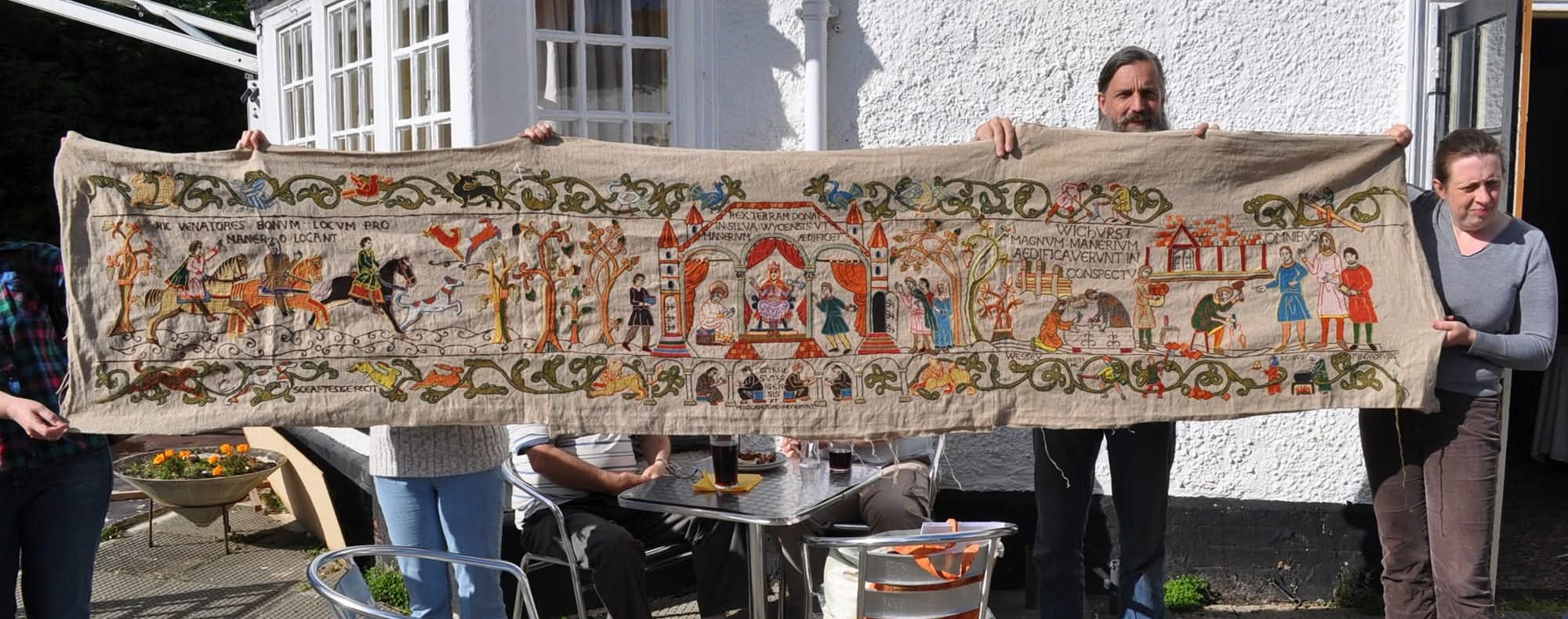
Panel 1
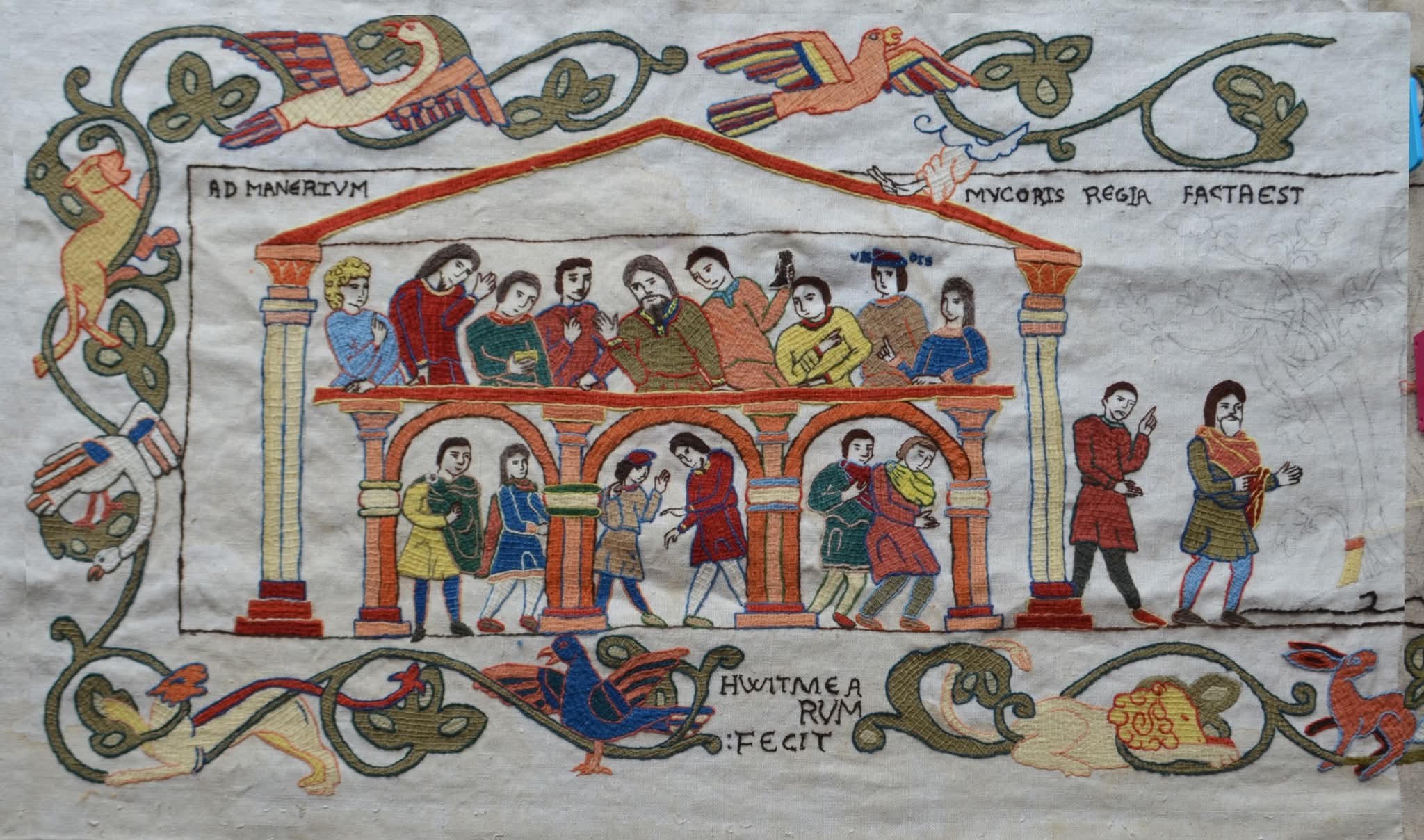
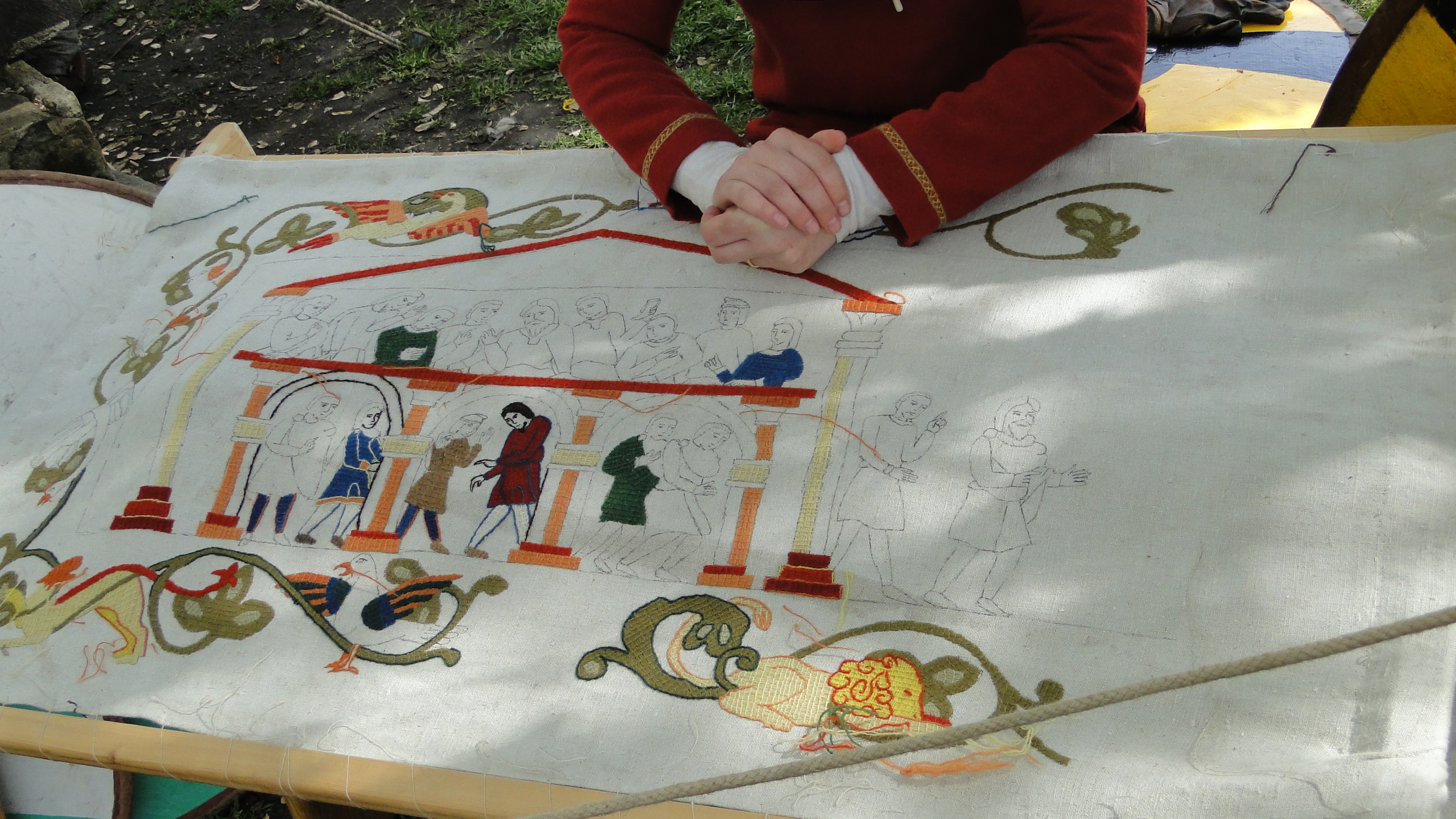
Ad manerivm mvcoris regia factaest
Regia Anglorum is founded at Mildew Manor.
This panel recalls the meeting of people in 1986, who decided to form a new living history society.
The people depicted here are the society founders, with the principle founder, Kim Siddorn, in the centre. “Mildew Manor” was a house in Bristol, not far from Kim’s house, where the founding members held a meeting and established Regia Anglorum.
Bottom border
Hwitmearvm Fecit
Hwitmearum made this
This panel was completed by the Oxfordshire group – Hwitmearum.
Panel 2
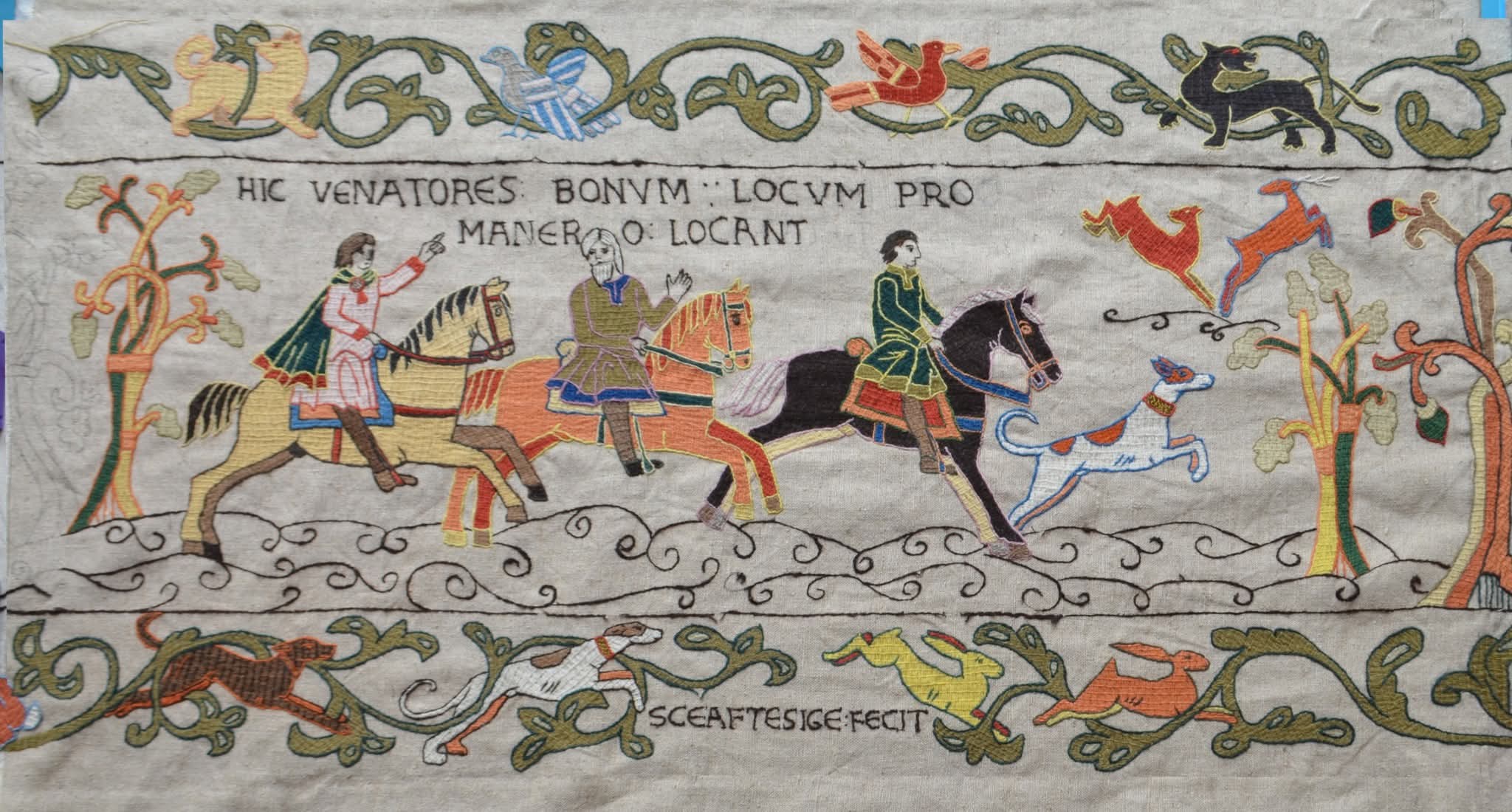
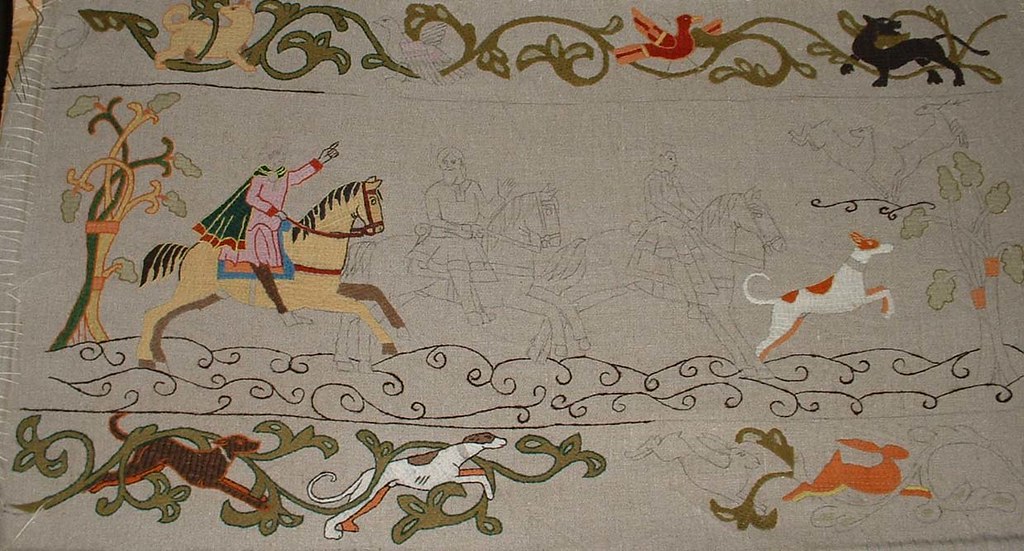
Hic venatores bonvm locvm pro manero locant
Here the hunters select a good spot for their camp.
In the late 1990s, the society moves to build a longhall, the hunting party setting up camp as depicted in this panel represents the search for a suitable patch of land.
Bottom border
Sceaftesige Fecit
Sceaftesige made this
This panel was completed by the Berkshire & Buckinghamshire group – Sceaftesige.
Panel 3

Rex terram donat in silva wycensis vt manerivm Ædificet
The King grants land in the forest of Wychwood for the building of a manor.
“The King” here represents Kent County Council, from whom planning permission is sought and gained to build the longhall.
Bottom border
Eithne Svthrvgensis et Middleseaxe Fecervnt
Eithne of Surrey and Middlesex made this.
This panel was completed by the “Eithne” (Glenys Crocker) of the Surrey and Middlesex groups – Suþrige and Middleseaxe.
Panel 4
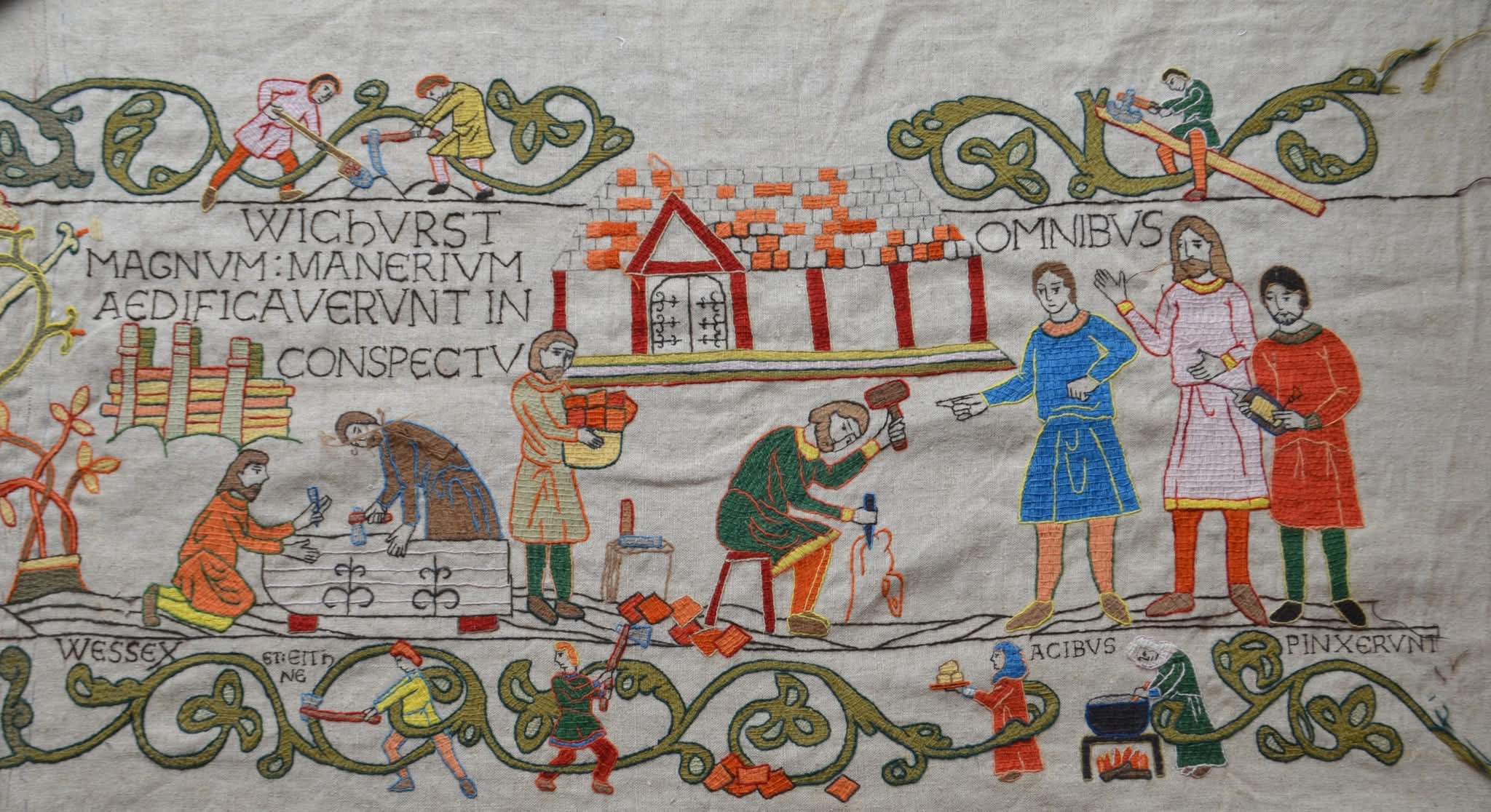
Wychvrst omnibvs magnvm manerivm aedificavervnt in conspectv
They built a large manor at Wychurst, in full view of everyone.
This panel recalls how, in the early 21st century, the longhall begins to take shape.
Bottom border
Wessex et Eithne acibvs pinxe
Wessex and Eithne embroidered with needles.
This panel was completed by Wessex – the Bristol group – and “Eithne” (Glenys Crocker).
Panel 5

Travelling and boats. This panel is still being embroidered. It is currently being worked on by Galweg – the group in Dumfries and Galloway.
Panel 6
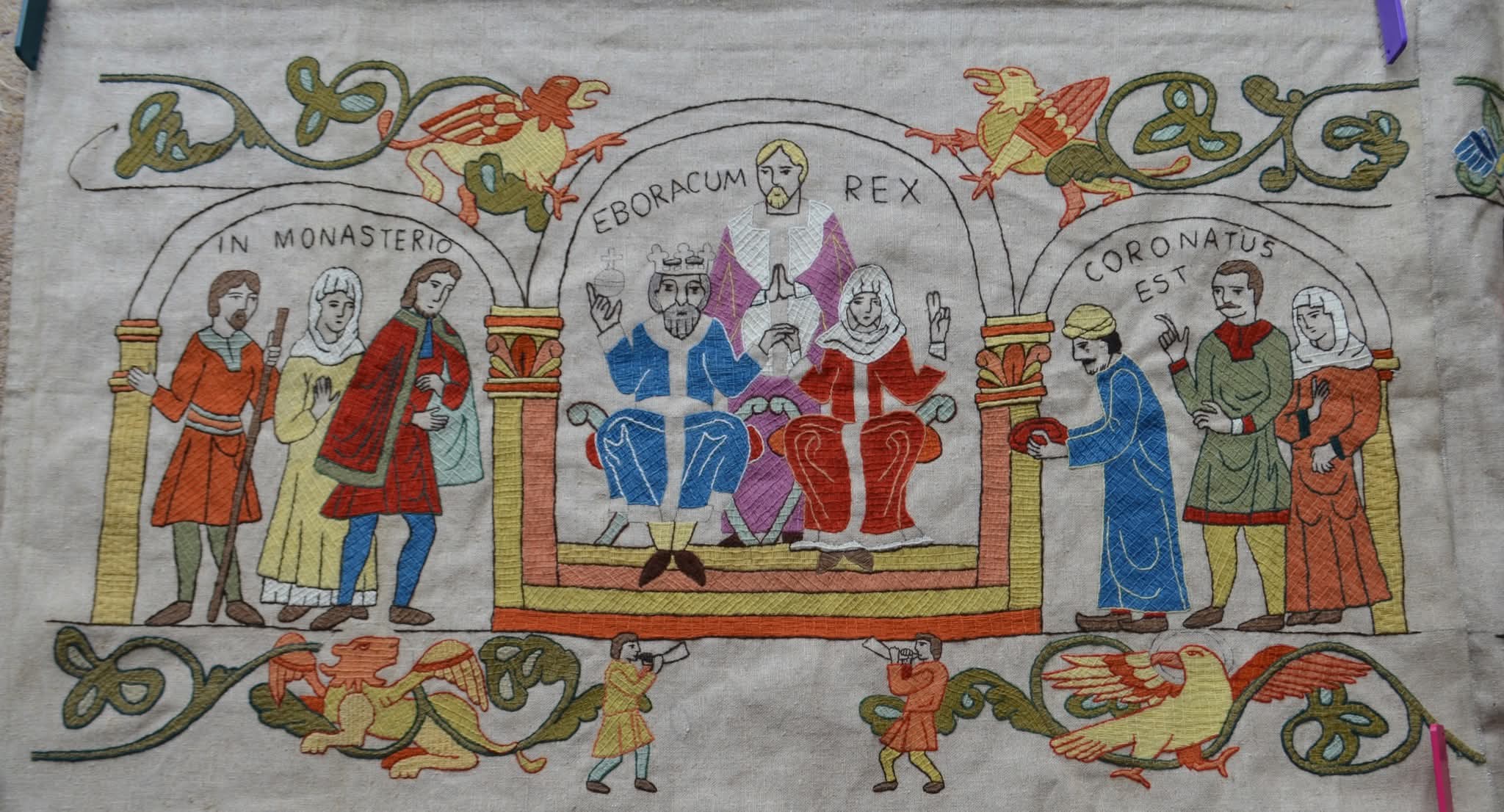
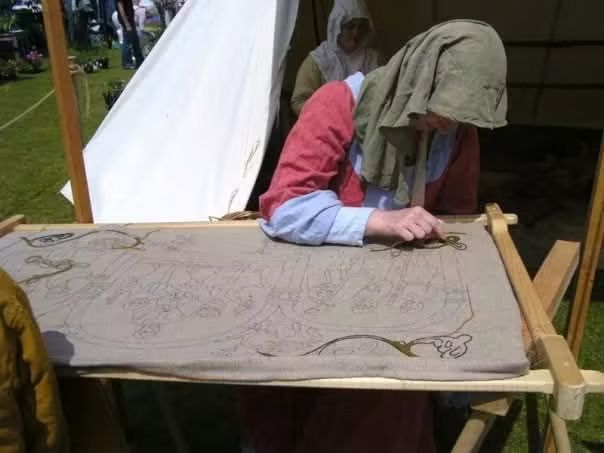
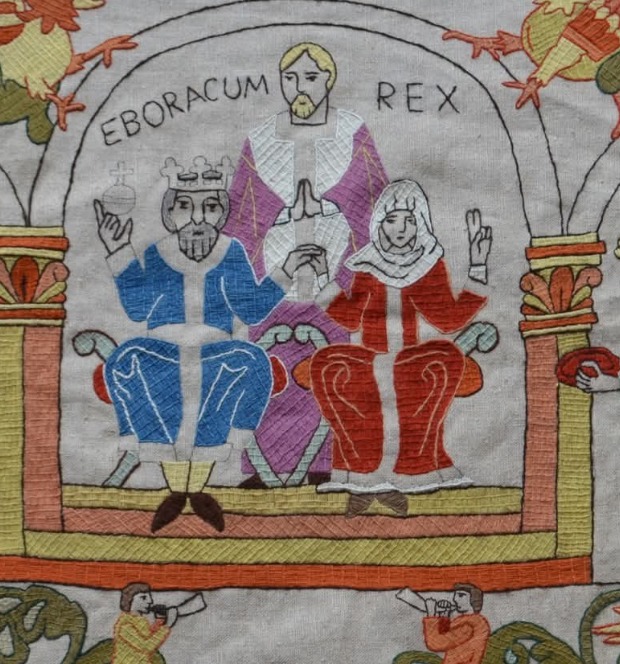
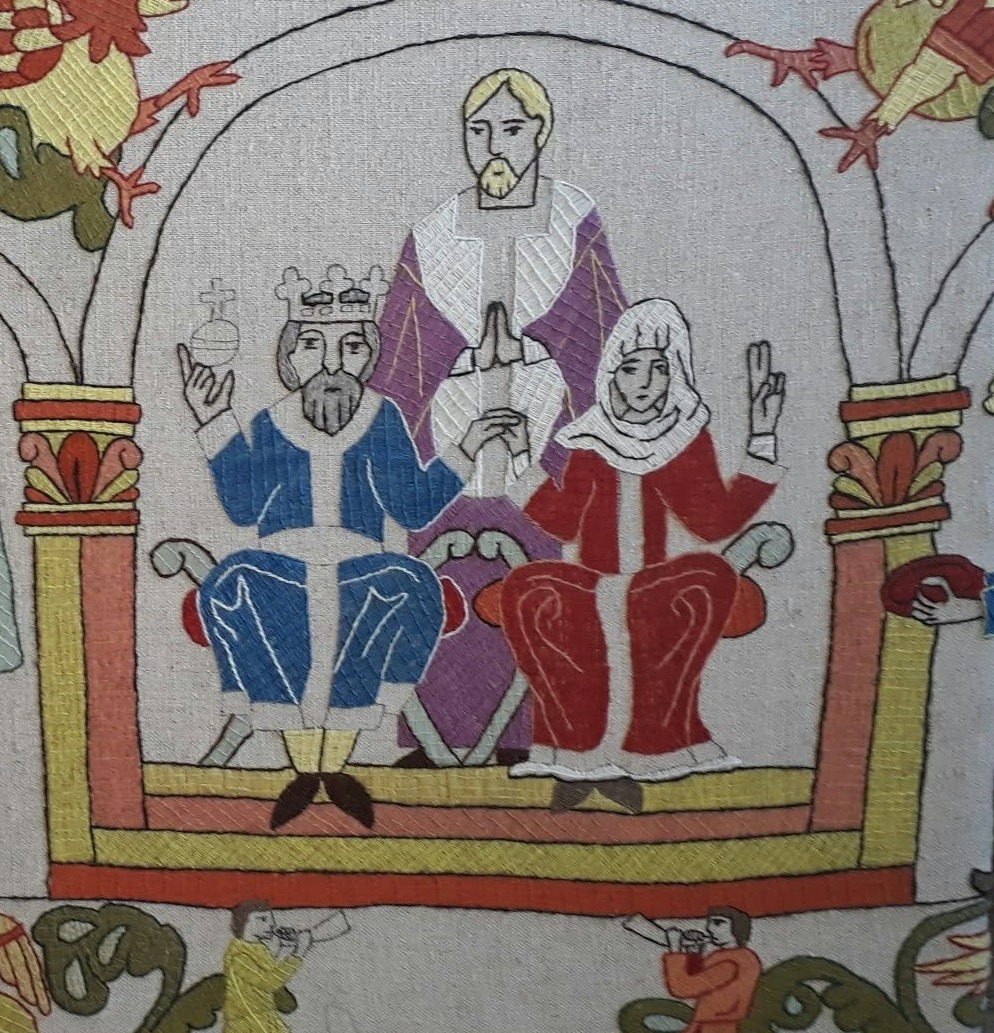
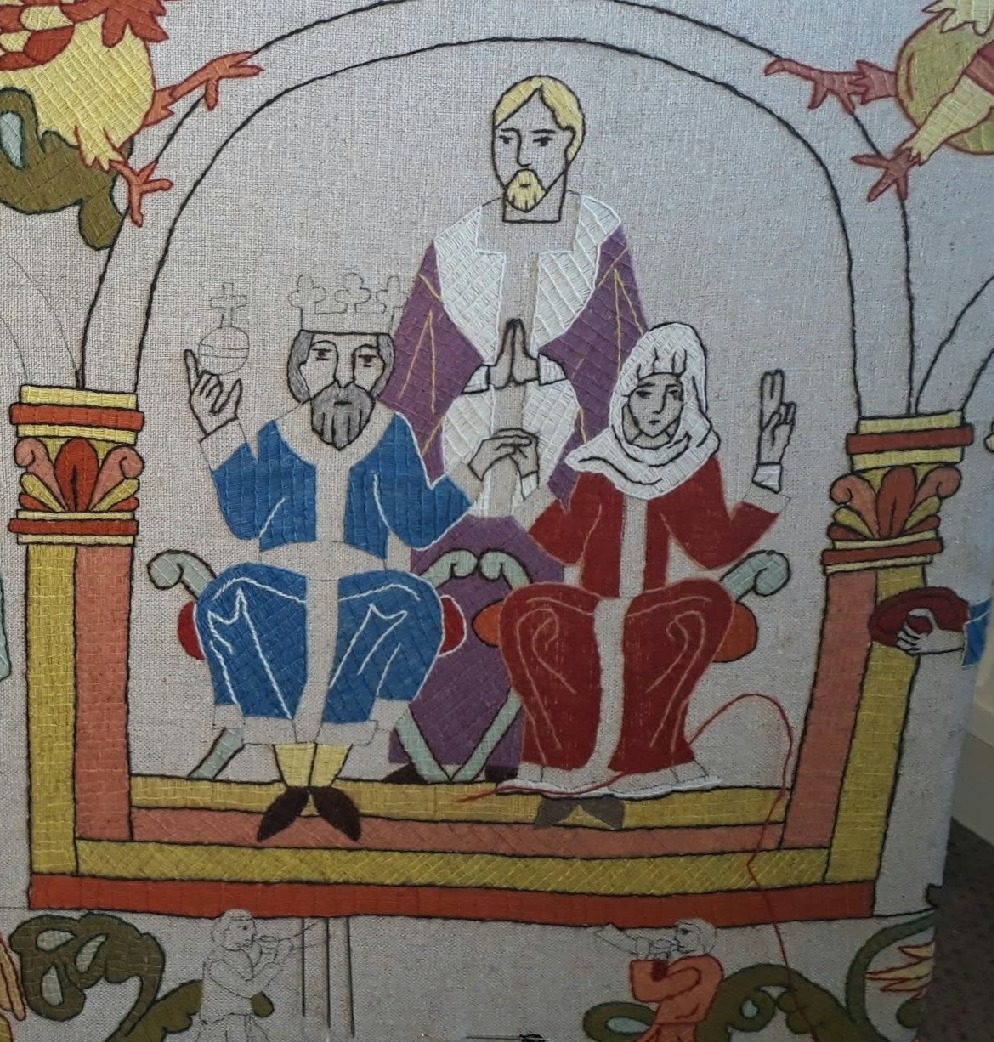
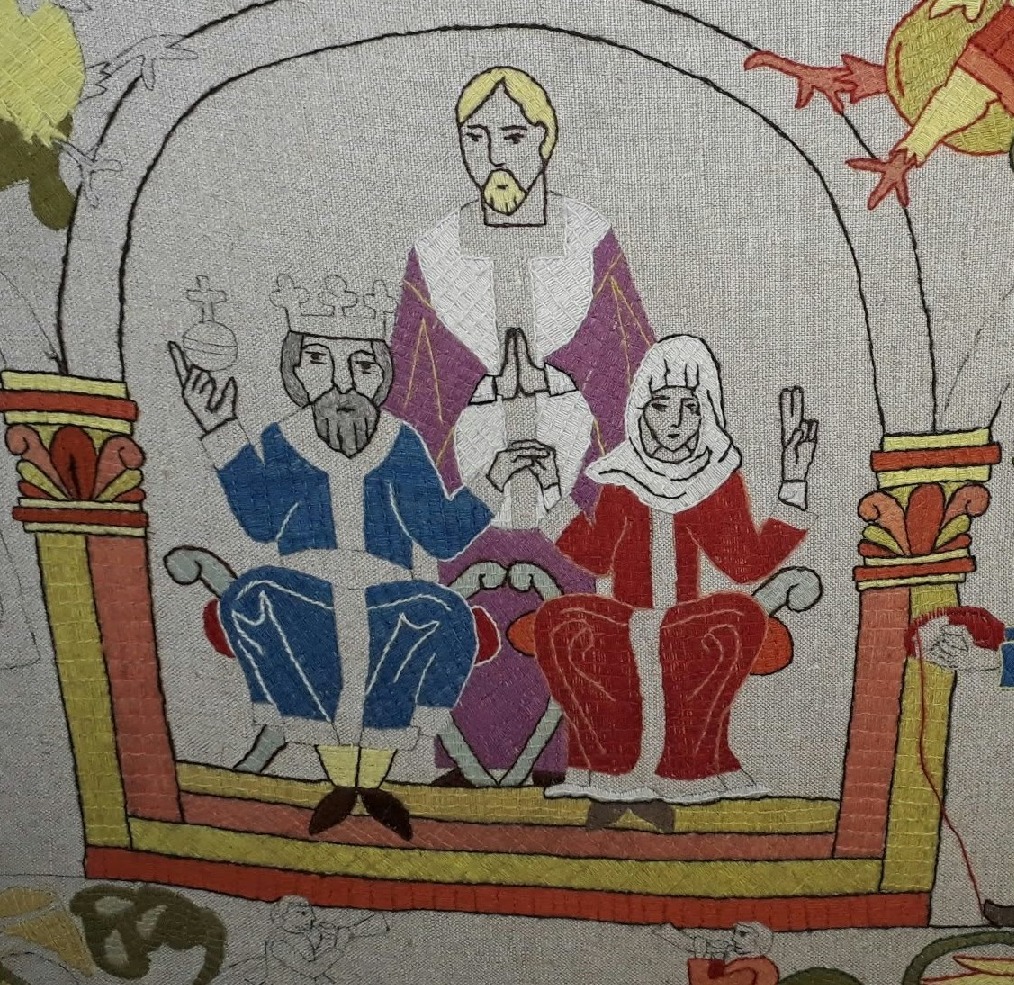
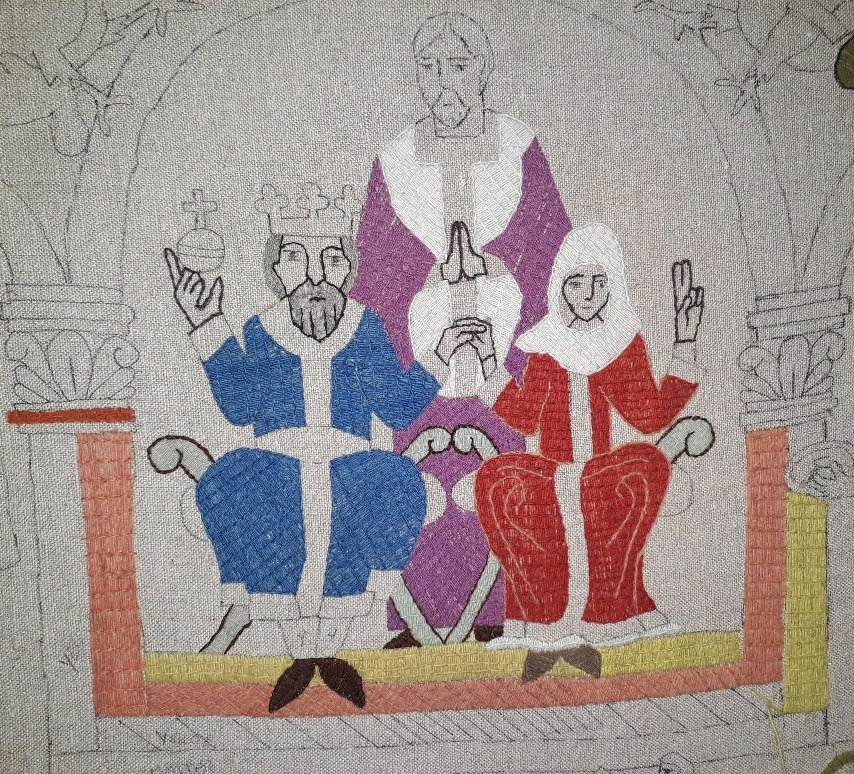
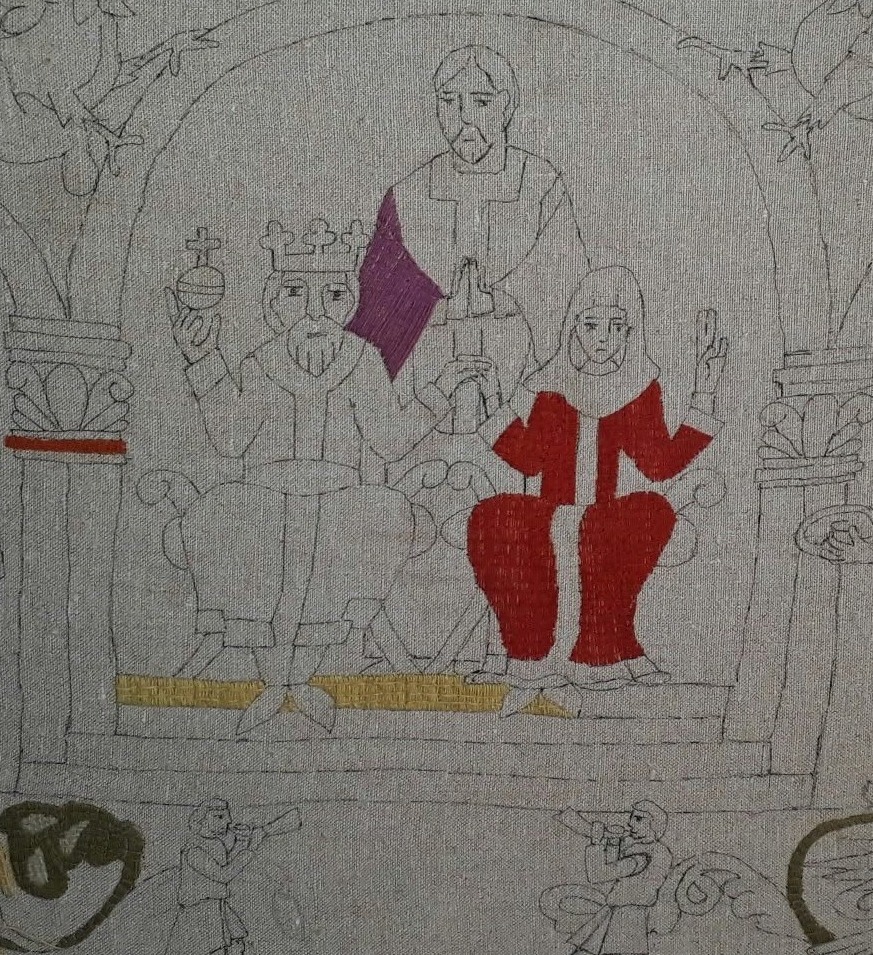
In monasterio eboracvm rex coronatvs est
The king was crowned in the abbey at York.
This recalls the period coronation at York Minster.
It was started by the Nottinghamshire group – Conroi de Vey – before being passed to the Lancashire group – Croix du Nord – where it was completed by Ted Jones.
See the coronation develop
Ted took photos to track his progress over the winter of 2017-2018.
Panel 7
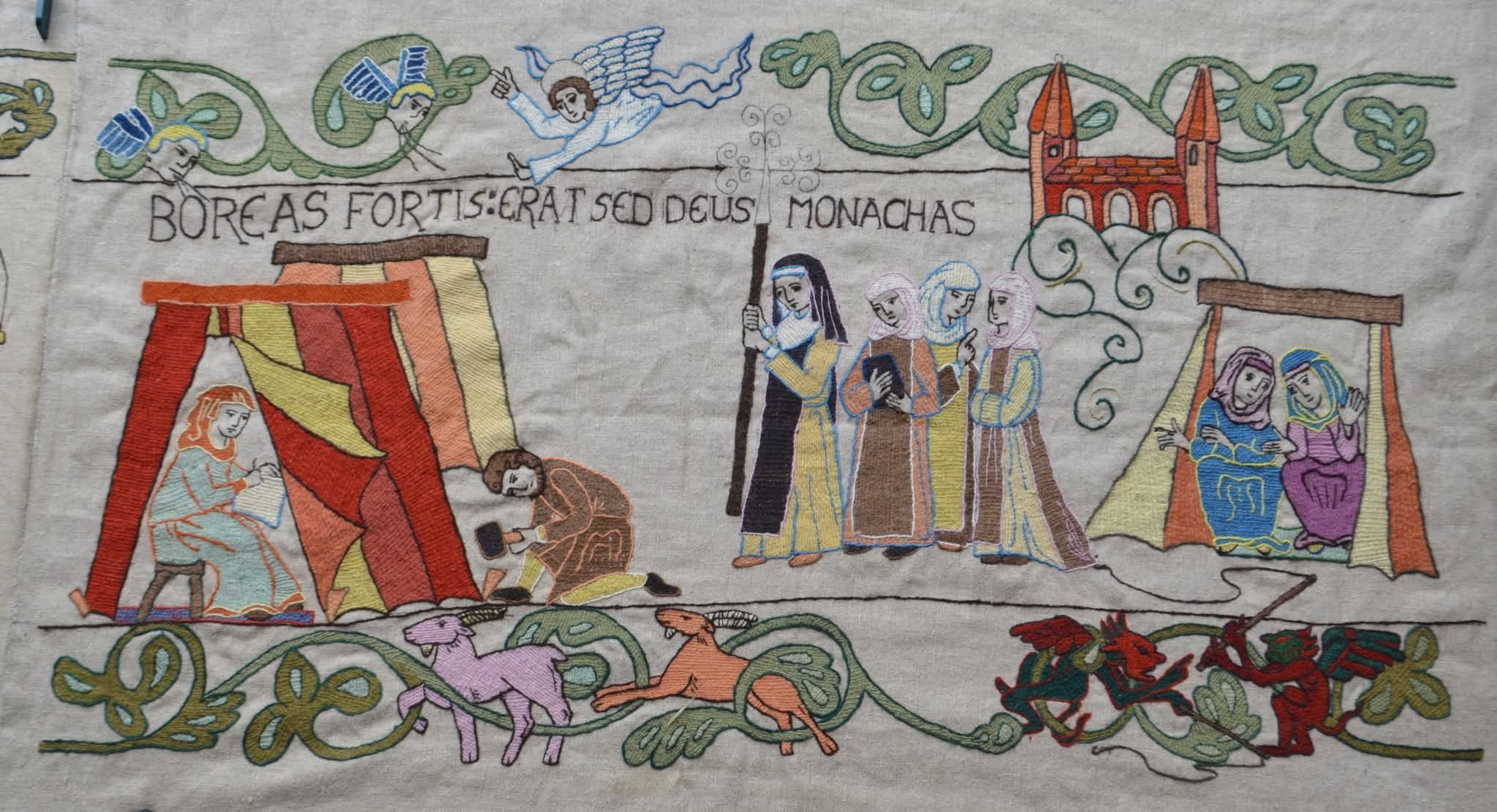
Boreas fortis erat sed devs monachas
The north wind was strong, but God protected the nuns.
This panel recalls a very windy show at Whitby Abbey, where tents were blown down by strong winds as people slept within them.
Panel 8
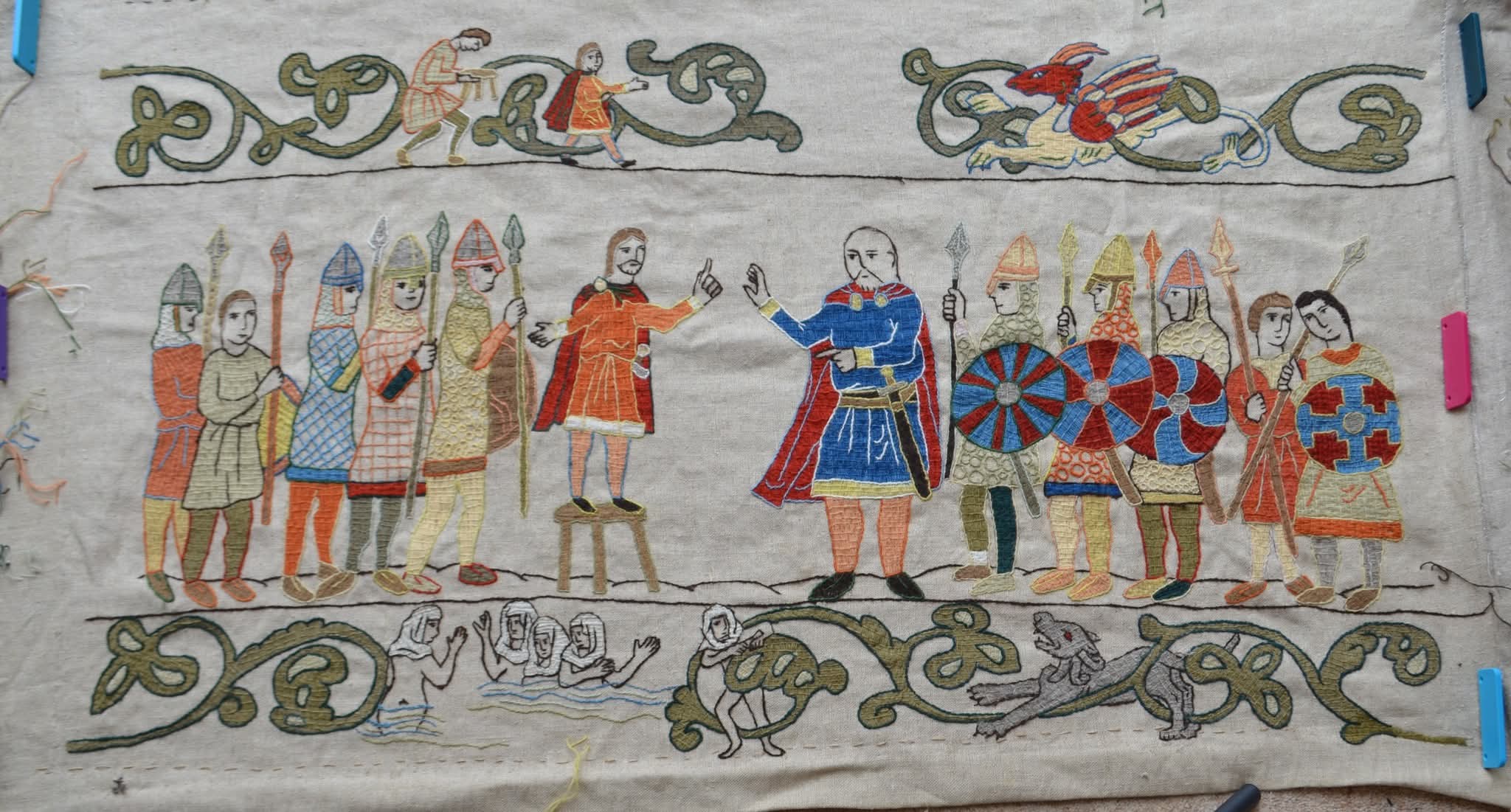
The Fritton Lake “disagreement”
This panel recalls a memorable event at Fritton Lake on the Norfolk-Suffolk boundary.
Bottom border
The Regia nuns can be seen skinny dipping in Fritton Lake itself.
Panel 9
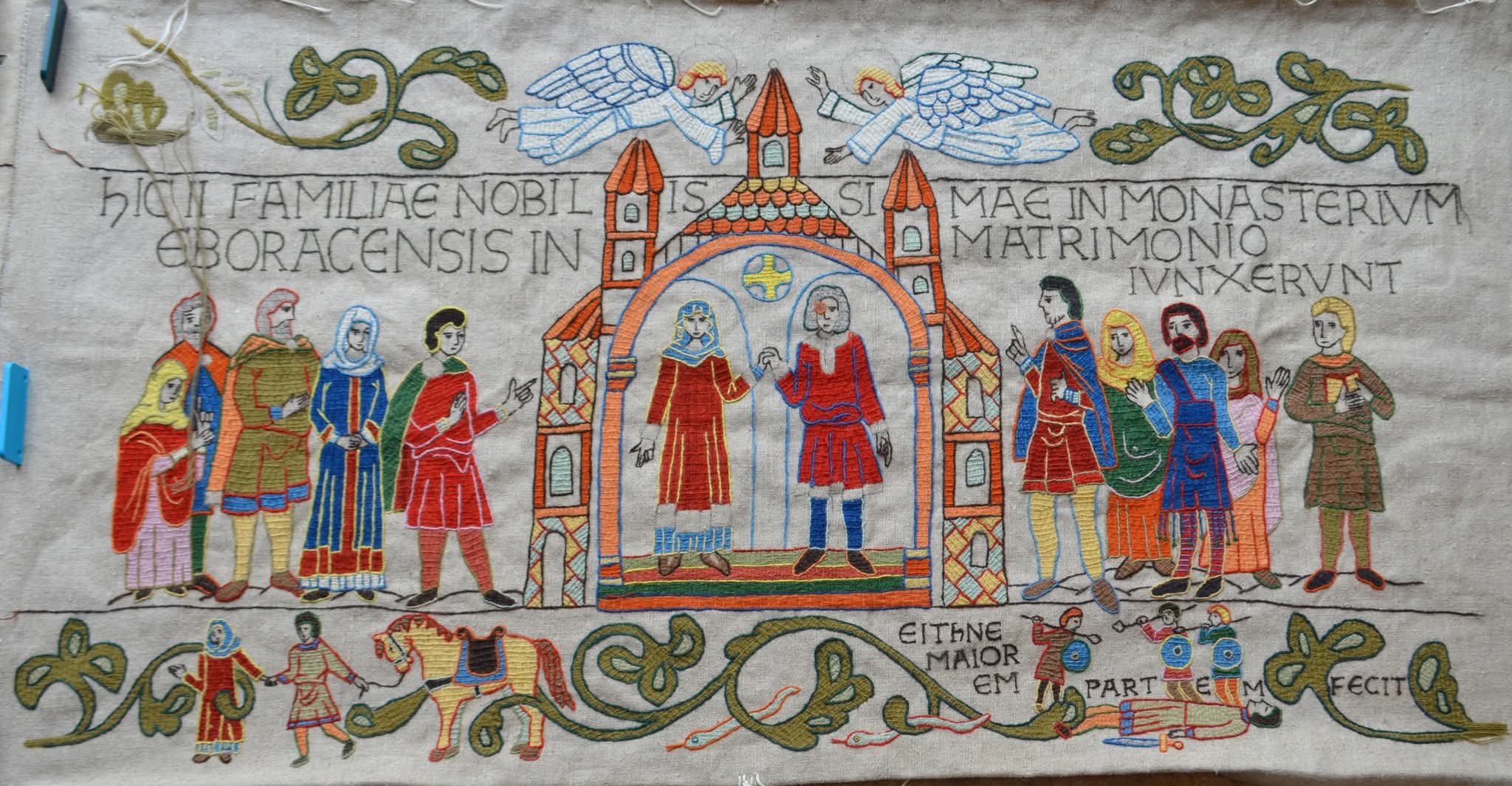
Hic II familiae nobilis simae in monasterivm eboracensis in matrimonio ivnxervnt
Here, members of two most noble families were united in matrimony at the abbey of York.
This panel recalls the grand spectacal of a period wedding in the halls of York Minster.
Bottom border
Eithne maiorem partem fecit
Eithne made the greater part.
Mostly done by “Eithne” (Glenys Crocker).
Panel 10
Bed burial
The original panel 10 was unfortunately damaged beyond repair. It is being re-drawn and will be re-started.
Panel 11
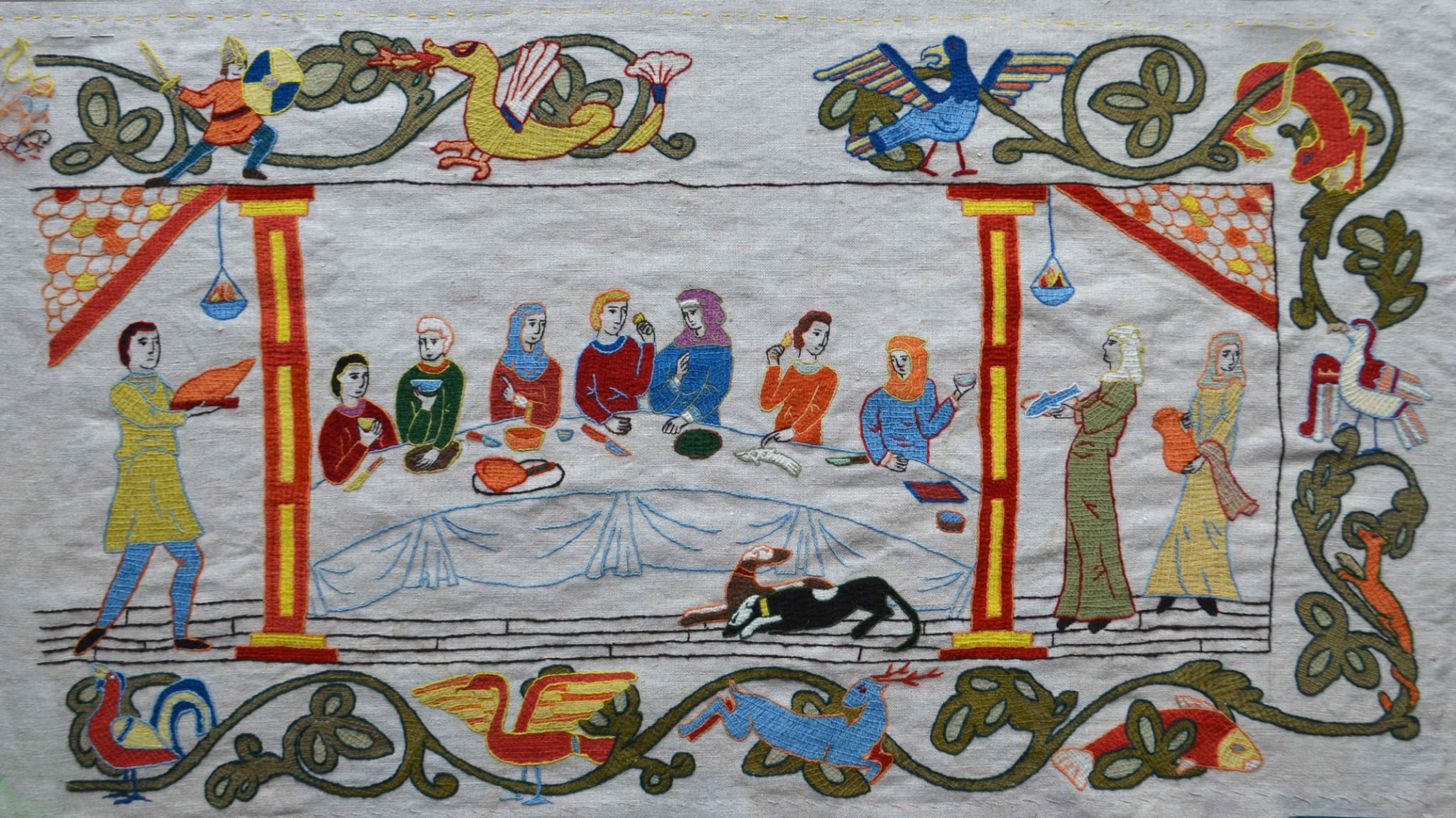
The final panel shows a great feast at Wychurst.
History
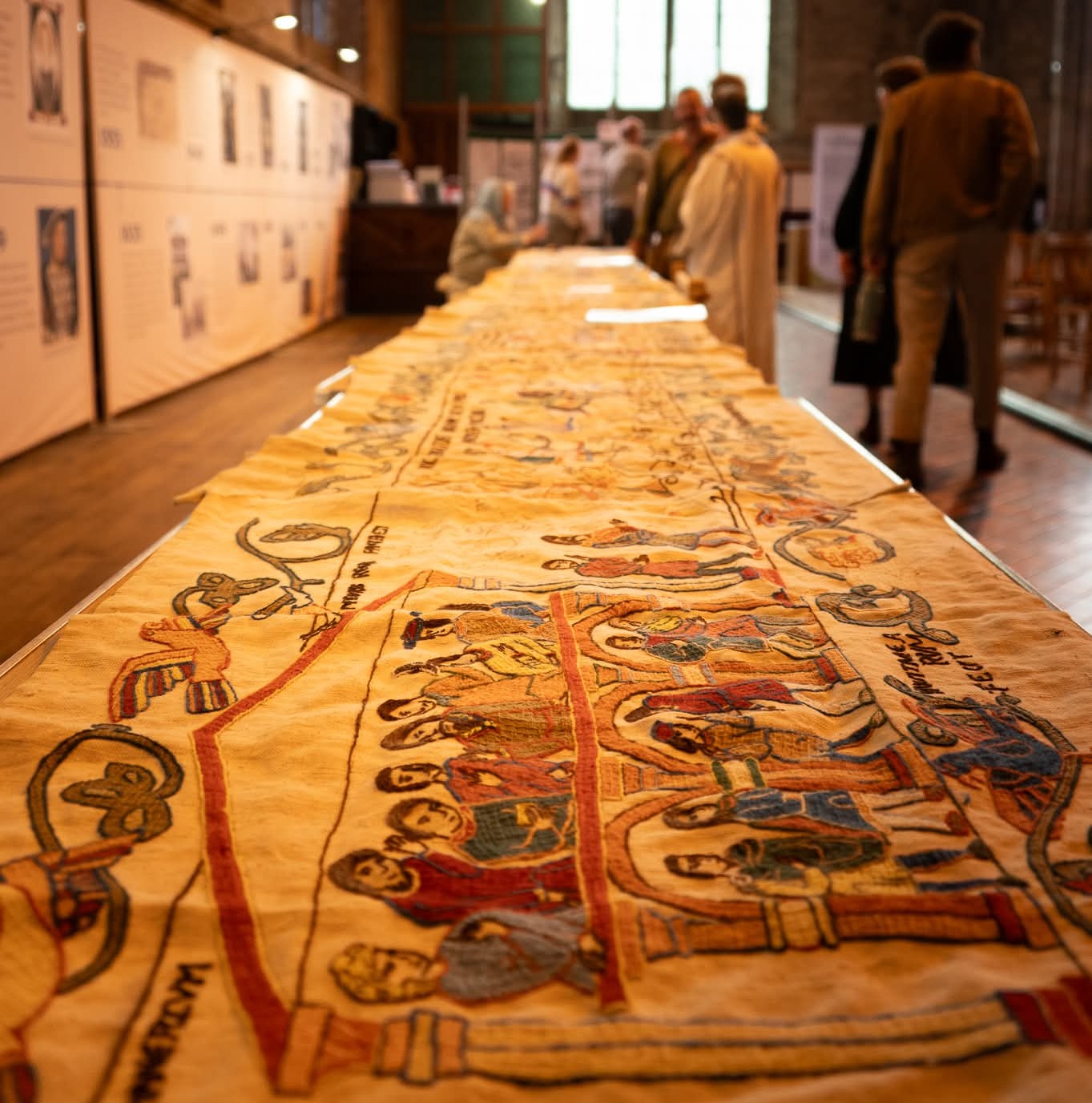
The embroidery was drawn up in the first decade of the 21st century, and highlights the main achievements of the society within its first 20 years.
Idea
The concept was to create something for Wychurst that could involve groups that were too far away to visit regularly and take part in the building (Kim’s idea). A Regia version of the Bayeux Tapestry in manageable segments was decided on. Initially the design was smaller and revolved round just the creation of Wychurst. At the suggestion of Nigel Amos, it expanded to encompass the story of founding of Regia.
Latin text was provided by Martin Williams.
Artistic designs
The artistic designs were done by Liz Da’born.
The overall design and art style is based on the Bayeux Tapestry: borders with commentary and willowy figures. The same art style was used by Liz when painting the internal walls of the Longhall. Each of the metre-long panels were designed with a main subject and relevant borders, extra fabric on either side was left so that when joining, the seam could be hidden and additional embroidery and framing lines connected. Some panels had a more complex design, the intention was for more experienced people to do these sections.
Logistics
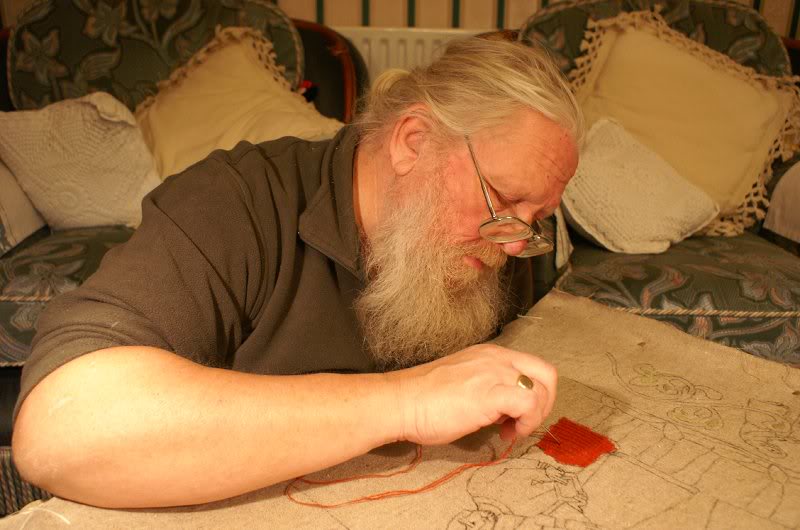
Each Panel was sent out in kit form. Fabric with outlines, full sized paper outline with colour instructions, labelled dyed yarn, embroidery frame, and instructions. There were only two stitches required: stem stitch and Bayeux stitch (also called layed and couched).
Fabric and colours
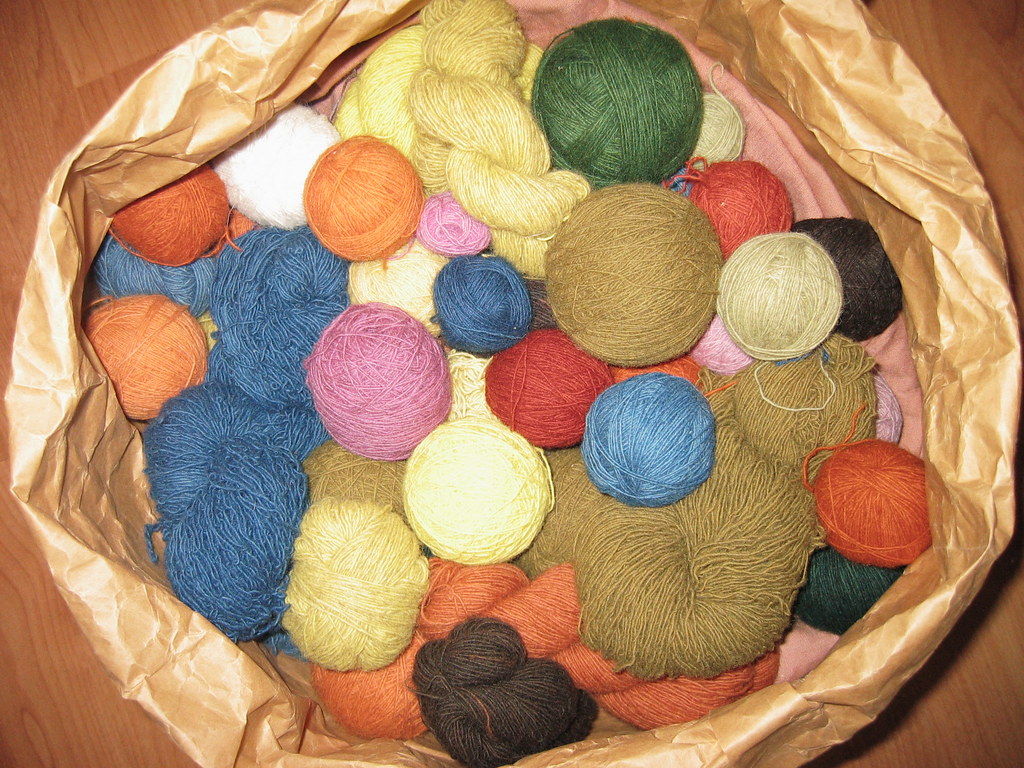
The undyed, coarse weave natural linen, on which the embroidery is laid out, was gifted to the society by Anwar Ali of Herts Fabrics.
The wool used for the embroidery threads was mostly purchased as undyed, lace weight yarn and was dyed by members within the society using natural dyes and authentic period techniques prior to being sent out. Colours used are more varied than the Bayeux Tapestry. This was an opportunity to show the breadth of colour achievable from natural dyes. Shade choices were made from the Regia Dye Project.
All the colours were obtained using just four dyestuffs:
- Weld (yellows and some greens);
- Madder (reds and oranges);
- Woad (blues);
- Lichen (purple)
Some colours were achieved by overdyeing using two colours (e.g. the bright greens using weld and woad). There are small quantities on handspun natural coloured wool (such as the dark brown border edge) and some panels are highlighted with gold thread, e.g. the King’s crown.